Most people notice something is off with their hair before they can name what it is. The ends feel rough. Color looks flat two weeks after an appointment. Frizz that used to be manageable now takes over by noon. These are not just bad hair days. They are signals that your hair needs more than a regular shampoo and conditioner.
At David Ryan Salon on Cross Timbers Rd. in Flower Mound, our stylists have been assessing these exact patterns for local clients for years, and an in-salon treatment is usually the clearest path back to hair that actually behaves. Ready to find out which treatment your hair actually needs? Our team at 4151 Cross Timbers Rd. is ready to help.
Key Takeaways
- Persistent dryness, breakage, and dull color are the most consistent signs that a professional hair treatment is overdue.
- Mineral buildup can settle on the cuticle and make fresh color look dull over time.
- Treatments like deep conditioning, Olaplex, and keratin smoothing each target different types of damage, so the right choice depends on your hair’s condition.
- Addressing hair concerns early can help you and your stylist plan the right next step before further damage develops.
What a Professional Hair Treatment Actually Does
Most people assume a good conditioner and a professional treatment are doing the same job, just at different price points. They are not. Conditioner can improve surface feel and manageability. A stylist can recommend a targeted service when hair needs more support than an at-home routine provides.
The Difference Between a Conditioner and a Treatment
Professional treatments are formulated to work inside the hair shaft, not just on top of it. A deep conditioning treatment can help replenish moisture after frequent washing and heat styling. A conditioner disperses that surface-level dryness temporarily. A stylist can recommend a treatment when hair needs more support than an at-home routine provides. That distinction matters more than most clients realize before they book.
The Main Treatment Categories at a Salon
In reality, professional hair treatment covers a broad range of services, each with a different mechanism. The team at David Ryan Salon works with four primary categories:
- Deep conditioning: Can improve softness and manageability for hair that feels dry or rough.
- Bond-building treatments, including Olaplex, are designed to support hair that has been stressed by chemical services and heat styling.
- Keratin and Brazilian Blowout treatments: Can smooth the hair surface, reduce frizz, and improve manageability. Results vary by hair type and aftercare.
- Protein treatments: May be considered when a stylist identifies signs of weakness or porosity.
Each category targets a different problem. Knowing which one your hair actually needs is where a consultation with our stylists makes the difference between a treatment that works and one that does not.
Signs 1 Through 4: What Your Hair’s Texture Is Telling You
Texture changes can be a useful signal that your routine or service plan needs a stylist’s input.
What Does Rough Hair After Washing Mean?
Rough or straw-like hair right after washing means the cuticle layer, the outer protective scale of each strand, has lifted and can no longer lie flat. It is not product buildup, because buildup washes out. A surface conditioner will temporarily smooth it, but the underlying damage remains. This is the scenario where a deep conditioning treatment or a bond-building service does the actual repair work, not your at-home routine.
How Do I Tell Breakage from Shedding?
Breakage and shedding can look similar in your brush. If you are seeing short snapped pieces or more shedding than usual, ask a stylist to assess your hair before choosing a treatment.
Sign 3: Lost Elasticity
If a wet strand snaps immediately or remains stretched after gentle tension, schedule a professional assessment before your next color or chemical service.
Sign 4: Unmanageable Frizz
Frizz is a cuticle problem. A raised, rough cuticle lets humidity enter the hair shaft unevenly, causing the strand to swell in unpredictable directions. Humid weather can make moderately damaged hair react badly.
Mineral buildup can compound the effect by leaving deposits on the hair shaft. A keratin smoothing service seals the cuticle and significantly reduces that humidity response. It is the most consistent treatment match our team recommends for clients whose frizz has moved past what styling products can manage.
Not sure whether your hair needs moisture or protein? Schedule a hair health consultation and our stylists will run an elasticity and porosity assessment before recommending anything.
Signs 5 Through 7: What Your Color and Chemical History Reveals
Color-treated hair follows a predictable pattern when the underlying structure is compromised. The shade fades faster than it should, brassiness returns before your next appointment, and wet hair feels wrong in a way that is hard to describe. Once you understand that these are porosity problems rather than product problems, the solution becomes more obvious.
Why Does My Color Fade So Fast?
Color that looks noticeably dull within two to three weeks may be related to porosity, product routine, or other factors a stylist can assess. Damaged cuticles sit open rather than lying flat, and open cuticles cannot hold color molecules in place, so every wash pulls more pigment out than it should. Our Hair Color Services include a consultation that assesses your porosity level before any formula goes on, because applying color to a compromised cuticle without addressing the structure first is a short-term fix at best.
A bond-building treatment applied before or during the color appointment helps the cuticle seal properly so the color has somewhere to stay.
Sign 6: Brassiness Returning Too Quickly
Toner molecules are small and sit close to the surface of the hair shaft. They depend on a smooth, closed cuticle to stay in place. When brassiness returns within three to four weeks of a gloss or toner service, the cuticle is too porous to hold those molecules through normal washing and heat styling. Clients who have had balayage often notice this pattern because lightened sections are naturally more open at the cuticle.
Anyone who spends summer weekends swimming adds chlorine exposure on top of existing porosity, which accelerates the problem further. A smoothing or bond-repair treatment between color appointments is the most direct way to extend toner results.
Sign 7: Gummy or Mushy Texture When Wet
Gummy or mushy texture when the hair is wet is one of the clearest signs of over-processing our team sees. It means the protein bonds inside the cortex have broken down to the point where the strand cannot hold its shape under tension. The hair stretches and does not spring back the way healthy hair does. This is a signal to stop all chemical services immediately and book a professional assessment before any further color or relaxer work is done.
Continuing chemical services on hair in this condition may increase the risk of further breakage, so a stylist should assess it first. A damaged hair repair appointment focused on protein reconstruction is the appropriate next step, not another color service.
Environmental and Lifestyle Factors Flower Mound Hair Faces
Texture and color history tell part of the story. The other part comes from where you live and how you spend your time. Daily washing, heat styling, and environmental exposure can create compounding stressors that most home care routines are not built to handle.

Sign 8: Hard Water and Chlorine Exposure
Mineral buildup can accumulate on the hair shaft over time, leaving it rough or dull and affecting how color looks. If your color looks flat faster than it used to, buildup may be a contributing factor.
Swimming can add chlorine exposure on top of mineral buildup, which can be challenging for color-treated hair. A clarifying treatment followed by a deep-conditioning approach can help remove buildup and improve manageability.
Sign 9: Heat Styling Losing Effectiveness
If your flat iron or curling iron is not performing the way it used to, and you find yourself making two or three passes where one used to do the job, that is a sign of protein depletion in the cortex. The internal structure of the hair has broken down to the point where it cannot hold a style under normal heat. The instinct is to turn up the temperature, but that makes the underlying problem worse.
A protein treatment rebuilds that internal structure so heat styling works at a lower, safer temperature. The heat tool has not changed. The hair has.
Sign 10: Oily Roots, Dry Ends
This pattern is common across the area, particularly through the summer months. Heat pushes the scalp to overproduce oil while the oldest, most processed ends become increasingly dry and brittle. The result is a hair condition that a single shampoo or conditioner cannot address, because the two zones have opposite needs.
This sign also tells our team that the home care routine is not calibrated to the hair’s actual condition. A stylist assessment resets the plan. Our haircut and treatment services are designed to address both zones in the same appointment, so the scalp and the ends are treated as separate problems rather than one.
If any of these signs sound familiar, our team can assess what your hair actually needs. Call us at (972) 691-0022 to schedule an appointment at our Flower Mound location.
Which Professional Treatment Matches Which Signs
Not every struggling strand needs the same fix. The signs your hair is showing point toward a specific kind of damage, which means choosing the wrong treatment can waste time and money, or in some cases, make things worse. The team at David Ryan Salon uses the signs as a decision framework, not a menu.
When Deep Conditioning Is the Right Call
If your hair feels rough, looks dull, or has dry ends that drink up product without improving, moisture deficiency is the likely cause. Signs 1, 4, 8, and 10 all point here. That distinction matters because deep conditioning works on the outer cuticle and cortex, driving hydration into a strand that is porous but structurally sound.
It is applied under heat to open the cuticle fully, which allows the treatment to penetrate rather than coat the surface. Results are not permanent, so our stylists typically recommend repeating it every four to six weeks. Our page comparing a salon treatment to your daily routine explains how this works in more detail.
When Bond-Building or Protein Treatments Come First
Breakage, lost elasticity, gummy texture after washing, and rapid color fade are signs of cortex-level damage. Signs 2, 3, 5, and 7 fall into this category. Bond-building and protein treatments can be considered when a stylist identifies signs of chemical or heat-related stress. If you are planning a color appointment and you are showing any of these signs, this step comes first.
Applying color to a compromised strand without addressing the structure first makes the damage worse, not better. Our team frequently uses Olaplex in this role. Our post on how Olaplex works explains the bond-building mechanism in plain terms.
When a Brazilian Blowout or Keratin Treatment Is the Answer
Frizz that returns within days of styling, heat tools that stop producing smooth results, and hair that reacts to humidity are the clearest indicators for a smoothing treatment. Signs 4, 8, and 9 point here. A Brazilian Blowout can reduce frizz and improve manageability. Your stylist can explain expected results and aftercare based on your hair type.
For clients dealing with humidity-related frizz, this treatment category can be worth discussing with a stylist.
What to Expect When You Book a Treatment Appointment
The Consultation Before the Treatment
No one at our salon picks up a product and starts applying it the moment you sit down. Every treatment appointment begins with a conversation. Our stylists ask about your chemical history, how often you use heat, and what your water situation is at home. Mineral buildup can affect which treatment category makes sense for your hair. The consultation is where the real work starts, and it typically takes longer than most clients expect.
If you want to see who is doing this work, the Our Team page gives you a full look at our stylists before you book. We are located at 4151 Cross Timbers Rd., Suite 150, which puts us within easy reach of most neighborhoods on the west side of town.
How Our Stylists Assess Your Hair’s Condition
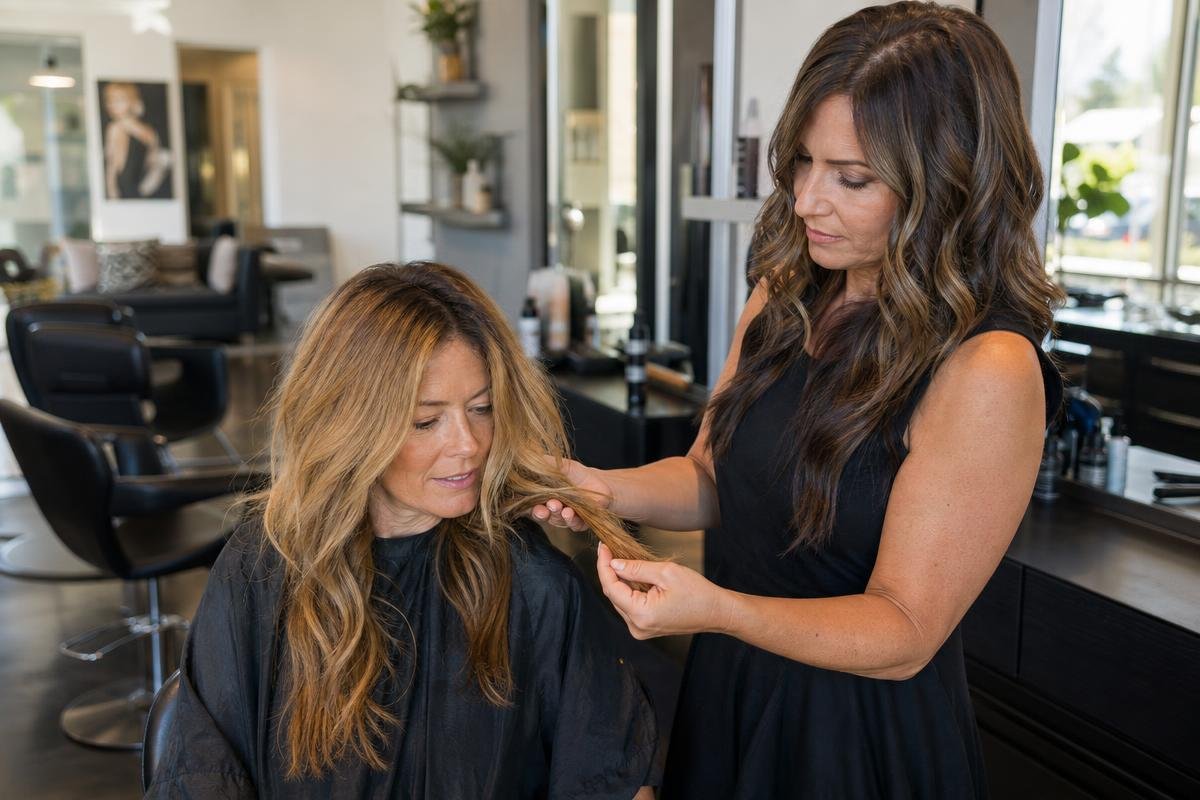
After the consultation, our stylists move into a physical assessment. This includes a strand test that checks elasticity and porosity, a close look at your ends under salon lighting, and an evaluation of your scalp condition. These are the same steps we use before any color service. The results tell us whether your hair is calling for moisture, protein, or a smoothing treatment, and whether a bond-building step should be added before any chemical service goes in. You can review the full menu of options on our haircut and treatment services page.
The assessment is what separates a professional hair treatment from anything you can do at home. A thorough consultation helps ensure the recommendation fits your hair’s condition.
Frequently Asked Questions
How often do I actually need to come in for a treatment?
For color-treated or regularly heat-styled hair, a deep conditioning treatment salon visit every four to six weeks is a reasonable baseline. If your hair is actively damaged, closer to every three to four weeks until the condition stabilizes. Once your hair holds moisture consistently and feels even in texture from root to end, you can space appointments out.
Can I get a treatment the same day as my color appointment?
Yes, and in many cases that is the better approach. Bond-building treatments like Olaplex can be added directly into the color formula or applied immediately after, protecting the hair’s internal structure during the chemical process rather than trying to repair it afterward. Our stylists will recommend the right timing during your consultation.
What is the real difference between a Brazilian blowout and a keratin treatment?
Both reduce frizz, but they differ in formula and how long results last. Expected longevity varies by formula, hair type, and aftercare, so ask your stylist what to expect from the treatment you are considering. The right choice depends on your hair type, how much frizz you are managing, and how long you want results to hold between appointments.
How much does a professional treatment cost?
Pricing varies based on hair length, treatment type, and whether the service is standalone or added to a color appointment. Book a consultation first. Our team will assess your hair and give you a clear price before any product is applied.
Will a treatment work if I have extensions?
Deep conditioning is generally safe for most extension types. Smoothing treatments require careful evaluation because heat and chemical exposure can affect the bond or the extension hair itself. Always disclose that you have extensions when booking so our stylists can plan accordingly. You can review our haircut and treatment services for more detail on what each service involves.
Is a professional treatment really different from a hair mask I buy at the store?
The difference is concentration and penetration. Professional formulas are higher concentration and applied with controlled heat, which allows the product to reach the cortex, the structural core of the hair strand. Store-bought masks condition the outer layer and are useful maintenance between appointments, but they cannot replicate that level of repair. Our page on how a salon treatment differs from your daily conditioner breaks it down in detail.
If you recognized more than two or three of these signs in your own hair, that is enough to act on. Call David Ryan Salon at (972) 691-0022 or book online to schedule a consultation. Our stylists will assess your hair’s current condition, walk you through the treatment options that fit, and give you a clear plan before any product is applied. We are at 4151 Cross Timbers Rd Ste 150, Flower Mound, TX 75028, easy to reach from Wellington, Canyon Falls, and the surrounding neighborhoods. The consultation is where the real work starts.
Ready to Get Started with David Ryan Salon?
Call (972) 691-0022 to speak with our team directly. We’re ready to answer your questions, walk you through your options, and help you find the right solution for your needs. Whether you’re just starting to plan or ready to move forward, we’ll make the process simple and stress-free. Reach out today and let’s talk about how we can help.