Most men pick a haircut because they saw it on someone else, showed a photo to their stylist, and hoped for a similar result. Sometimes that works. Often it does not, and the difference almost always comes down to face shape. The same cut that looks sharp and defined on one man can appear unbalanced or heavy on another, not because of the execution but because the proportions of the cut do not match the proportions of the face wearing it.
Face shape is the variable most men skip entirely when thinking about their hair, but it is the one that has the most impact on whether a cut flatters or fights their features. Once you know your shape, you stop picking cuts at random and start choosing ones that actually work with what you have.
Below, the team at David Ryan Salon covers all six men’s face shapes, what each one looks like, and the cuts our stylists at our Flower Mound salon and Trophy Club salon recommend most consistently for each.
How to Quickly Identify Your Face Shape
Pull your hair back completely and take a front-facing photo on your phone at eye level, one-times zoom, with even lighting and no angle. What you are looking for is the outline of your face from hairline to chin.
The four measurements that define face shape are your forehead width (across the widest point, roughly halfway between your brows and hairline), your cheekbone width (from the outer corner of one eye to the other), your jawline width (from one jaw corner below the ear to the center of your chin, doubled), and your face length (from your center hairline to the tip of your chin). Comparing those four numbers tells you which category you fall into. If you are still unsure after the photo and measurements, our stylists confirm your shape as the first step of every consultation.
1. Oval Face Shape: Work With What You Have
An oval face is longer than it is wide, with the forehead slightly broader than the jaw and a gentle curve through the chin. There are no hard angles or dominant features that need compensating for. The face is balanced in a way that most cuts simply do not disrupt, which is why oval is considered the most versatile shape for men’s hair.
The proportions of an oval face mean that very few styles are truly off-limits. That said, a common mistake men with oval faces make is defaulting to long, flat styles with no volume or texture. Very long hair worn heavy and straight with no structure tends to pull an already elongated face downward, making it appear longer. The goal is to maintain the shape’s natural balance rather than inadvertently pushing it toward oblong.
What Our Stylists Recommend
The textured crop is one of the most reliable cuts for oval faces. Shorter on the sides with a defined, textured top, it works with the face’s natural proportions without overcomplicating them. The crew cut is another go-to, particularly for men who prefer low maintenance. It keeps the shape clean, emphasizes the face’s structure, and requires almost no styling effort to look intentional.
Fades in all variations work well on oval faces because the graduation on the sides does not add width or compete with the shape. A high or mid fade paired with a textured top gives the cut dimension without changing the face’s proportions. For men who want to experiment, oval faces handle longer styles, undercuts, quiffs, and side parts equally well. The flexibility is real, and our stylists rarely need to talk an oval-faced client out of a cut they want.
2. Round Face Shape: Add Height, Reduce Width
A round face has a soft jawline and cheekbones that are roughly the same width as the face’s length. The overall impression is full and even, without strong angles or a defined chin. Round faces often read as youthful, but that same softness means cuts need to work harder to create the definition and sharpness that the bone structure does not provide on its own.
The primary goal for round faces is to create vertical length and introduce angles where the face is naturally curved. Width on the sides is the main thing to avoid. Cuts that sit heavy and full at the temples amplify the roundness rather than offset it. Anything that lies flat across the top of the head without volume does the same by removing the vertical line the face needs.
What Our Stylists Recommend
A high fade with a textured top is the strongest choice for round faces. The tighter graduation on the sides removes width at the temples and cheekbones while the volume on top creates a vertical line that elongates the face. The contrast between a clean fade and a textured crown is also one of the sharper looks in men’s haircuts right now, which works in the client’s favor on multiple levels.
The pompadour achieves the same effect with more volume and drama. Volume swept upward and slightly back creates significant height at the crown while keeping the sides tighter, making the face appear longer and more angular. A side part is a subtler option that still introduces the diagonal line round faces benefit from, breaking up the symmetry and reducing the impression of width across the cheeks.
What to steer away from: bowl cuts, blunt crops worn flat to the head, and any style that adds fullness at the sides without height on top. These push the face outward rather than upward and exaggerate the roundness.
3. Square Face Shape: Lean In or Soften Up

A square face has a strong, defined jawline and roughly equal measurements across the forehead, cheekbones, and jaw. The sides of the face are relatively straight from temple to jaw, and the jawline corners are angular rather than curved. Square is often described as one of the most classically masculine face shapes, and for most clients the goal is not to hide the jaw but to decide how prominently to feature it.
There are two distinct approaches to cutting a square face. The first is to work with the angularity, choosing cuts that are clean, structured, and confident. The second is to soften it slightly with texture and movement, particularly for men who prefer a less severe look. The right direction depends on the client’s personal style and how they want to present.
What Our Stylists Recommend
For men who want to lean into a square jaw, a crew cut or high fade with a short, neat top is a classic combination that suits the shape well. The structure of the cut matches the structure of the face, and the result is sharp and clean without trying too hard. A buzz cut is another option that works for the same reason: it does not compete with the jaw’s definition, it simply lets it stand.
For men who prefer to soften the angles, a mid fade with a textured top is the more popular recommendation from our stylists. Texture on top introduces movement that offsets the jaw’s rigidity, and the mid fade provides structure without the severity of a skin or high fade. A side-swept style with some volume and loose texture is another effective choice: the diagonal movement across the top draws the eye away from the horizontal line of the jaw, reducing the face’s boxy impression.
Avoid cuts that reinforce the squareness rather than work with it: a flat top or a very sharp, geometrically precise cut on a square face can read as overly blocky rather than strong. A center part worn with flat, sleek hair directly down the sides of the face also frames the jaw in a way that emphasizes its width.
4. Heart Face Shape: Balance the Forehead and Jaw
A heart-shaped face is widest at the forehead and temples and tapers down to a narrow, often pointed chin. The forehead tends to be the dominant feature, and the chin is the narrowest point of the face. The goal with hair on a heart-shaped face is to reduce the visual weight of the forehead and add apparent width at the jaw, creating a more balanced proportion between the upper and lower halves of the face.
Cuts that add volume at the crown or that sweep hair up and back from the forehead directly amplify the forehead’s prominence. Very short crops with no fringe and tight sides can also expose the full width of the forehead without any frame to soften it.
What Our Stylists Recommend
A textured fringe is the most practical recommendation for heart-shaped faces. A fringe that falls forward across the forehead, whether worn messily or with more direction, reduces the forehead’s apparent width by covering part of it. This does not need to be a heavy or full fringe; even a loosely textured top with some forward movement at the hairline makes a meaningful difference.
Medium-length cuts with layering through the sides and back add volume around the jaw and lower face, widening those zones visually to match the broader forehead. A low fade is a better option than a high fade for this shape, because a high fade strips the sides clean all the way up to the temple and makes the upper face appear even wider.
Side-swept styles also work well because they break up the forehead’s width asymmetrically. Moving volume to one side rather than leaving it centered reduces the impression of a wide, even band across the top of the face. For men who wear facial hair, a beard is particularly useful for heart-shaped faces: even light stubble or a short beard adds width and definition at the jaw that directly offsets the forehead’s prominence.
5. Diamond Face Shape: Work the Cheekbones
A diamond face has prominent, wide cheekbones as its defining feature. The forehead is narrow, the jawline is narrow, and the chin is often pointed. The cheekbones are significantly the widest point of the face, giving it a sharp, angular quality that is considered strongly masculine but can appear unbalanced if the cut adds more width at the cheekbones rather than distributing attention more evenly.
The styling goal for diamond faces is to add apparent width at both the forehead and jaw to balance the prominent cheekbones. Cuts that are very tight on the sides with a lot of volume concentrated at the very top can inadvertently draw the eye straight to the middle of the face where the cheekbones already dominate.
What Our Stylists Recommend
A textured crop with fringe is one of the top recommendations for diamond faces. The fringe adds horizontal coverage across the forehead, widening that zone visually to bring it closer in proportion to the cheekbones. The texture through the top softens the overall impression of the cut rather than creating a sharp, defined outline that emphasizes angles.
A side part worn with some volume works well for the same reason: it adds width at the hairline, which is one of the narrowest points on a diamond face. Keeping some length on the sides, rather than a very high or aggressive fade, also helps by not stripping the face of the soft framing it needs around the cheekbones.
Medium-length layered styles are a strong option for diamond faces because the layers distribute volume throughout the length rather than concentrating it at any single point. This diffused approach is more flattering than a cut that sits tight everywhere except for a defined volume on top, which tends to make the cheekbones the most visually dominant feature by contrast.
For men interested in color, strategic placement of lighter tones at the hairline and jaw can draw the eye toward the face’s narrower zones, reducing the visual dominance of the cheekbones. Our hair color services and balayage options can be tailored by your colorist to complement what your cut is already doing structurally.
6. Oblong Face Shape: Add Width, Control Height
An oblong face is noticeably longer than it is wide, with a relatively uniform width from forehead to jaw and sides that read as fairly straight rather than curved. The overall impression is tall and narrow. Oblong is sometimes confused with oval, but the key distinction is that an oblong face lacks the oval’s gentle tapering and balanced proportions, instead reading as consistently elongated from top to bottom.
The styling goal for oblong faces is to introduce horizontal width and reduce the vertical impression. Adding height on top is the one thing that makes an oblong face appear even longer, and it is also one of the most common instincts men have when thinking about cuts, so this shape benefits from being deliberate about what it puts on top.
What Our Stylists Recommend
A textured side-swept fringe is the top recommendation for oblong faces. The fringe does two things at once: it reduces the forehead’s contribution to the face’s overall length by covering part of it, and the horizontal sweep of the fringe adds a visual width line across the upper face that offsets the vertical proportion. Even a soft, loosely worn fringe with forward movement at the hairline achieves both of these effects.
A medium-length crop with volume through the sides rather than the top is another strong choice. Keeping weight on the sides adds horizontal fullness that counters the face’s length. The sides should not be faded too tightly, since removing all volume at the temples leaves the face looking even narrower. A low or mid fade with a fuller, fuller-sided top is more flattering than a high fade with a sharp, towering top.
Avoid anything that adds significant height at the crown, including pompadours and quiffs, unless they are kept very low. A center part worn with long, flat hair also makes an oblong face appear longer by creating a clean vertical line from the center of the hairline all the way down. Instead, a side part with some texture and movement breaks up that vertical emphasis and reads as more balanced.
Beard and Facial Hair: A Variable the Haircut Cannot Control Alone
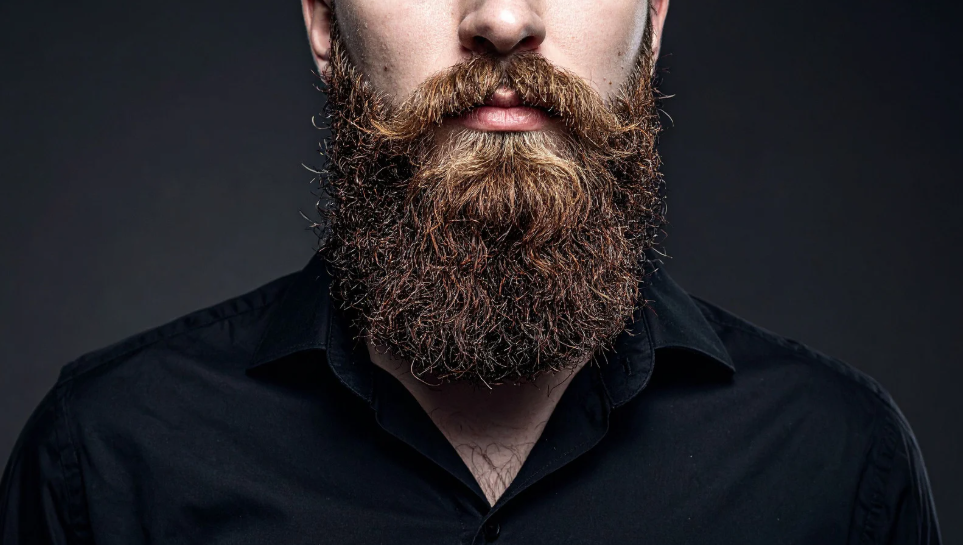
For men who wear facial hair, the beard is part of the same proportional conversation as the haircut. The two should work together rather than independently, because a beard that fights the face shape can undercut everything the cut is doing.
Round faces benefit from a beard that adds length and definition at the chin. A short beard kept neater on the sides and slightly longer at the chin introduces a vertical line that elongates the face, reinforcing what the haircut is already trying to achieve. A full, round beard that adds volume evenly on all sides does the opposite.
Square faces are one of the few shapes where a full beard works naturally. The jaw’s strength holds the beard’s width without the face appearing overly wide, and the beard can even add length at the chin that moves the shape closer to oval. Men who want to soften a square jaw should keep the beard light and textured rather than hard-edged and defined.
Heart-shaped faces benefit most from a beard. Even short stubble at the jaw adds apparent width to the face’s narrowest point, directly addressing the shape’s primary proportional challenge. This is the one face shape where a beard consistently adds more than the haircut alone can accomplish.
Oblong faces should be thoughtful about beard length. A short beard with a rounded chin profile can help contain the face’s length and add a little horizontal weight at the jaw. A very long, pointed beard extends the face’s vertical dimension and should generally be avoided.
Our hair cuts and treatments services include beard trims and shaping for clients who want their facial hair calibrated to match their cut and face shape.
About David Ryan Salon
David Ryan Salon has served clients across North DFW from our locations in Flower Mound and Trophy Club since 2010. Founded by master stylist and educator David Ryan, our team delivers precision cuts, custom color, and personalized styling for every client who walks through the door, men included. Every appointment begins with a consultation because we know that the right cut starts with understanding your face shape, your hair’s texture, and how you actually live your life. David Ryan Salon is here to help you find the cut that works for you.
Frequently Asked Questions
How do I figure out my face shape quickly?
Pull your hair back and take a straight-on photo at eye level with even lighting. Look at where your face is widest, where it narrows, and whether it reads as longer or roughly equal in length and width. The four measurements that nail it down are forehead width, cheekbone width, jawline width, and face length. If you are between two shapes, your stylist can confirm during a consultation.
What is the best men’s haircut for a round face?
A high fade with a textured top is the most reliable choice. It removes width at the temples and creates vertical height that elongates the face. A pompadour or quiff achieves the same effect with more volume. The key is to avoid any style that adds fullness on the sides without height on top, as that amplifies the roundness rather than offsetting it.
What haircut suits a square jaw best?
It depends on whether you want to lean into the jaw’s strength or soften it. For a clean, structured look that works with the angularity, a crew cut or high fade with a short top is a natural fit. For something softer, a mid fade with a textured top introduces movement that offsets the jaw’s definition without fighting it.
Are fades good for all face shapes?
Most face shapes handle fades well, but the height of the fade matters. High fades work best on oval, round, and square faces where the goal is to reduce width or add structure. For heart, diamond, and oblong faces, a mid or low fade is usually more flattering because it preserves some volume at the sides, which these shapes need for balance.
Does a beard help with face shape?
Yes, meaningfully. For heart-shaped faces in particular, even light stubble adds jaw definition that the face’s natural proportions lack. For round faces, a beard shaped longer at the chin adds length. For square faces, a full beard is one of the few face shapes that can carry significant beard volume without the face appearing too wide.
What should men with oblong faces avoid?
Avoid adding height on top. Pompadours, quiffs, and any style that builds significant volume at the crown extend the face’s vertical length visually. Also avoid a center part with long flat hair worn straight down, which creates an uninterrupted vertical line from hairline to chin. A fringe, side part, and volume on the sides are the tools that work for this shape.
Does men’s hair texture affect which cuts work for a face shape?
Significantly. A textured crop on fine, straight hair will fall and behave differently than the same cut on thick, wavy hair. Coarse hair may hold volume at the sides when a round-faced client needs reduction there. Curly hair naturally adds volume that can work for or against the face depending on where it falls. Your stylist factors texture into every cut recommendation alongside face shape.
Book Your Appointment at David Ryan Salon
Ready to find a cut that actually fits your face? Our team at David Ryan Salon serves men and women throughout the Flower Mound and Trophy Club area from two full-service locations. Call us at (972) 691-0022 or book online through our website. Not sure where to start? Bring in a photo, tell us what you have been getting, and we will take it from there.